



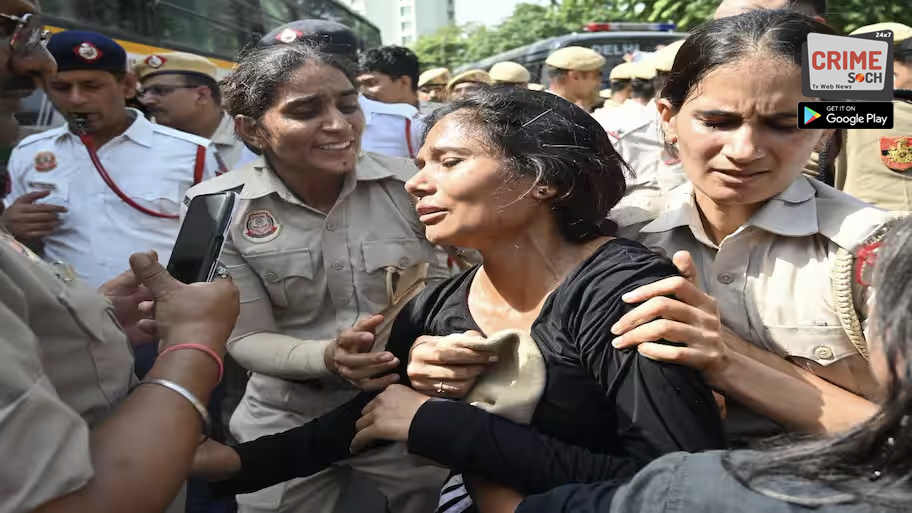
Police personnel deployed at Delhi’s Jantar Mantar during protests demanding Chief Election Commissioner Gyanesh Kumar’s resignation were seen without name tags. Officials familiar with the deployment said the decision was taken deliberately to prevent individual personnel from being identified and targeted on social media, according to Hindustan Times (HT).
The protests are over allegations of irregularities in the Special Intensive Revision (SIR) of electoral rolls. Demonstrations began at Jantar Mantar on Friday, October 1. Hundreds of protesters were detained over the weekend while trying to reach the protest site.
The police decision on name tags dates back to the experience of personnel during the July 20 Cockroach Janta Party (CJP) march. Thousands of protesters had tried to march towards Parliament from Jantar Mantar over alleged examination paper leaks and demanded the resignation of then Union education minister Dharmendra Pradhan.
The march ended in clashes, with the police using tear gas and baton charges to disperse protesters who breached barricades. More than 100 police personnel and over 60 protesters were reported injured.
Officials said several police personnel involved in crowd control were later identified on social media. Their families also became targets of online posts and memes, said the publication, citing an officer familiar with internal review meetings held after the July clashes.
“Many officers said their families were called out by friends or in social circles. Some officers even reported that their families had been deliberately targeted by colleagues at work and through memes on social media,” the officer said, according to the report.
The experience influenced the police approach at Jantar Mantar this time. Senior officers were told that personnel would not face action for removing name tags if they were carrying out their duties within the law.
“While most IPS (Indian Police Service) officers, who are easily identified by the public, chose to retain their tags at Jantar Mantar this time, many junior personnel were allowed to be on the ground without wearing their tags,” the officer said, according to the report.
The decision was visible on the first day of the ongoing protests. Several demonstrators photographed police personnel and asked why their names were not displayed. Videos shared online showed some officers saying their tags had fallen off during the commotion. Others said they had forgotten to attach them. Some said they had removed the tags deliberately because they could come off during crowd control. Several personnel declined to explain the decision.
Why influencers are being watched
Police officers involved in the deployment reportedly told their seniors that some social media influencers were approaching the protest site while presenting themselves as journalists. Officials said some of them were recording police personnel and conducting live sessions that could later be turned into memes.
A second officer said, according to the report, the police had specifically identified such people during the ongoing protests.
“Time will tell the role or impact of the influencers in these protests, but one should acknowledge that there is a section of influencers who are deliberately doing live sessions or recording videos to make memes. These influencers are identifying and targeting some officers. Some are also interviewing police personnel on the ground to make memes. This is why the identity cards of people posing as reporters are being checked,” the officer told HT.
The approach follows a difficult July for the Delhi Police and central armed police forces. Several personnel were recorded on camera during the CJP protests slapping, assaulting and tripping demonstrators. The police faced criticism over the level of force used during the clashes. Officials said protesters had also breached barricades and acted violently during the march.
The Delhi Police held anti-riot drills and training sessions before the latest protests against Kumar. Personnel were told to keep their composure when influencers approached them with mobile phones and asked questions. They were also instructed not to feel intimidated by people recording them.
The Rapid Action Force (RAF) of the Central Reserve Police Force (CRPF) also changed its approach after the July experience. Following a review, RAF personnel were barred from giving interviews.
Name tags and conflict zones
The practice of removing identifying details from security personnel is used in areas affected by Left wing extremism, parts of the northeast and Jammu and Kashmir. Photographs from anti-insurgency operations often show the faces of special forces personnel blurred to prevent identification.
Officials said there are no written rules that specifically require Delhi Police personnel to either wear or remove name tags during crowd-control duties. The practice has been used operationally in conflict zones where identifying individual personnel can expose them to targeting.
During the July CJP protests, several civilians in plain clothes were accused of attacking demonstrators. Social media influencers later attempted to identify some of those people, with the police saying some were not Delhi Police personnel.
Self-styled influencer Swatantra Bhardwaj was later arrested in connection with an alleged assault on a 38-year-old man during the protest. The Delhi Police arrested him in Uttar Pradesh in connection with the case.
The latest protests at Jantar Mantar have led to tighter security in central Delhi. The police have used barricades and additional personnel to stop demonstrators from reaching restricted areas. On October 2, around 1,000 people were detained across the city during attempts by student groups and political parties to gather near designated protest site.
The city police has also registered three FIRs over attempts to hold the October 2 demonstration. The cases relate to alleged disobedience of official orders, obstruction of public servants and the use of force against public servants. No individual or organisation was named as an accused in the FIRs when they were registered.
The protests continued over the weekend. On October 3, female journalists accused police personnel of sexual harassment during the protest near Jantar Mantar. The Delhi Police Crime Branch has been assigned to examine the allegations. Officers are reviewing CCTV footage and other video material.